

Why use it
Get found inside AI
See whether AI assistants name you when buyers ask for recommendations.
Watch your competitors
Find out who AI mentions most often, and where you rank against them.
Track your share of voice
See your slice of all the AI mentions - and whether it’s growing.
Spot trends early
Notice when you start gaining (or losing) ground over time.
How to use it
1
Open AI visibility
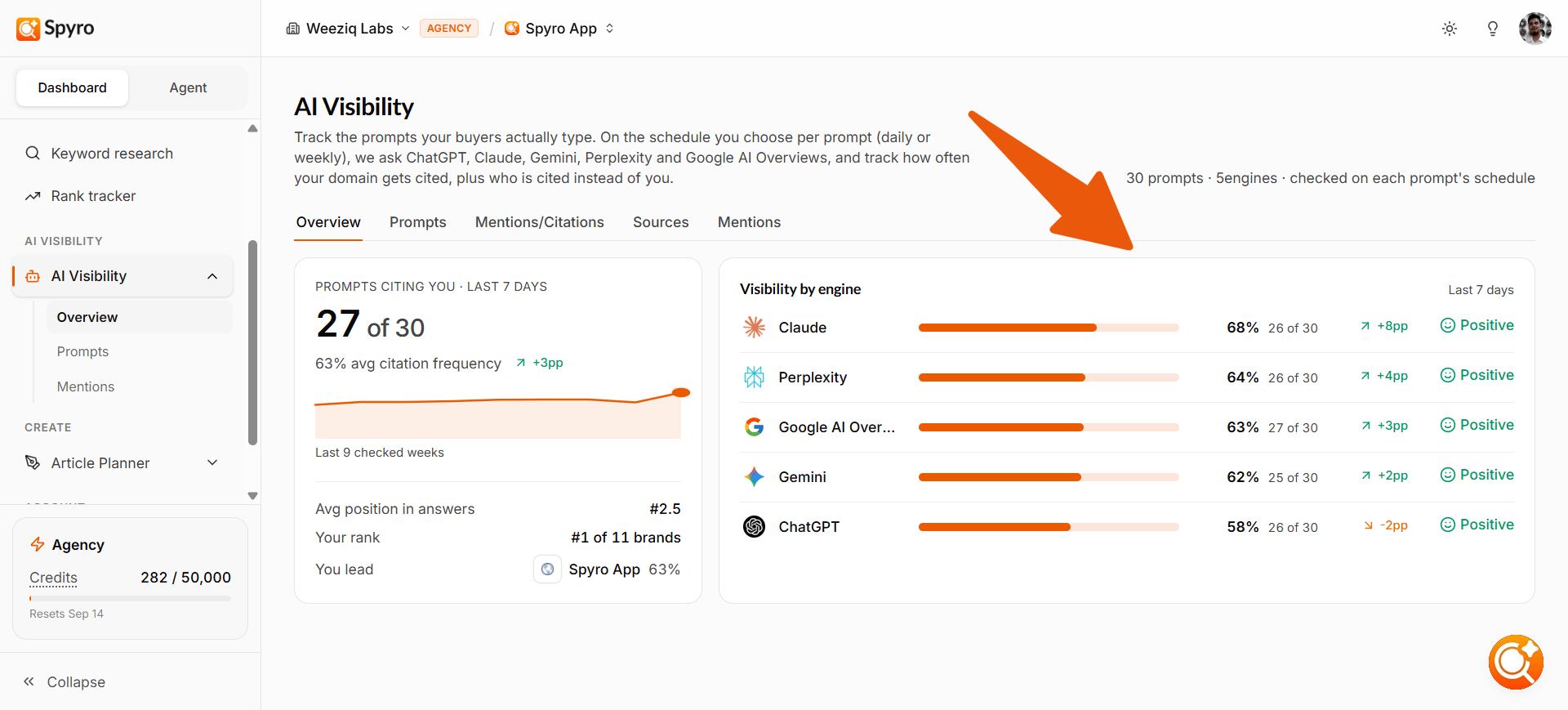
In the sidebar, open AI visibility. The main view shows how often each AI assistant mentions you, your share of voice, and your competitor ranking.
2
Check each AI assistant
At the top you’ll see a card for each assistant - ChatGPT, Gemini, Claude, Perplexity, and Google AI Overviews. Each card shows how visible you are there, how many times it mentioned you, and whether that’s going up or down.
3
Read your share of voice
The chart below shows your share of all the AI mentions over time, next to your top rivals. A growing slice means you’re winning more of the conversation.
4
See the competitor ranking
The Competitors table lists every brand the AI assistants mention for your questions, ranked from most-mentioned to least - with a highlighted You row so you can see exactly where you sit.
What “share of voice” means
Think of every mention the AI assistants make as one vote. Share of voice is simply your slice of all those votes. If the assistants mention five brands and yours is named in a third of the answers, you have about a third of the share of voice. It’s a relative number, so it can change in two ways:- You climb when the assistants start naming you more often.
- You slip when a competitor surges ahead - even if your own mentions stayed the same.
The competitor ranking
The Competitors view is where you go head-to-head with your rivals. It lists every brand the AI assistants mention for your questions and ranks them from most mentioned to least. Your own row is highlighted with a You badge, so you can spot your rank at a glance. For each brand you can see:- Its rank - who AI mentions most for your kind of questions.
- How many of your questions it shows up in.
- How often it gets mentioned, and whether that’s rising or falling.
What to expect
- Because AI answers vary each time, Spyro never gives a simple yes or no. Instead you’ll see results like “mentioned in 3 of 5 checks” - a frequency that’s fairer and more reliable than a single answer.
- Your first results appear right after you add your buyer questions, and Spyro re-checks every week so your numbers stay fresh.
- If you haven’t added any questions yet, this view will be empty - start by adding a few tracking prompts.
Tips
- Pair this view with its two companions: Tracking prompts to manage the questions Spyro asks, and AI mentions to read the actual answers word for word.
- When a rival outranks you, note which questions they win, then study those answers to see what they’re doing differently.